

How Brand Positioning Can Help You Win Marketshare
How you position your brand is a key part of your growth, engineer the perception and show your audience you are the ones to solve their problem.

How Brand Positioning Can Help Your Startup Stand Out
Most startups don’t fail because their product is bad. They fail because they aren’t able to show the market how they fair up against competitors. Nobody understands what they do, why it matters, or why anyone should choose it over something familiar.
In today’s hyper-competitive tech landscape, you have only a few seconds to communicate your value before people scroll, bounce, or forget you. This is why positioning is the most underrated growth lever a founder has. Done correctly, it turns confusion into clarity, noise into attention, and products into brands.
This article gives you a practical, founder-friendly framework for building a powerful position in the market, one that cuts through competition and sticks in the minds of customers, investors, and partners.
What is Brand Positioning?
Brand positioning is how the market perceives you relative to alternatives.
It answers questions like:
- What category are you in?
- How are you different from competitors?
- When should someone choose you?
It’s important to differentiate brand positioning from brand narrative:
- Brand positioning is logical. It’s the rational framing: category, problem, value, differentiation.
- Brand narrative is emotional. It’s the story, the identity, the ambition behind the product.
Together, they create the “lens” through which your audience interprets your product. If you don’t create that lens, the market will do it for you, usually by diluting your value.
The Four Fundamental Blocks of Brand Positioning
Before crafting any positioning, founders must answer four simple yet difficult questions.
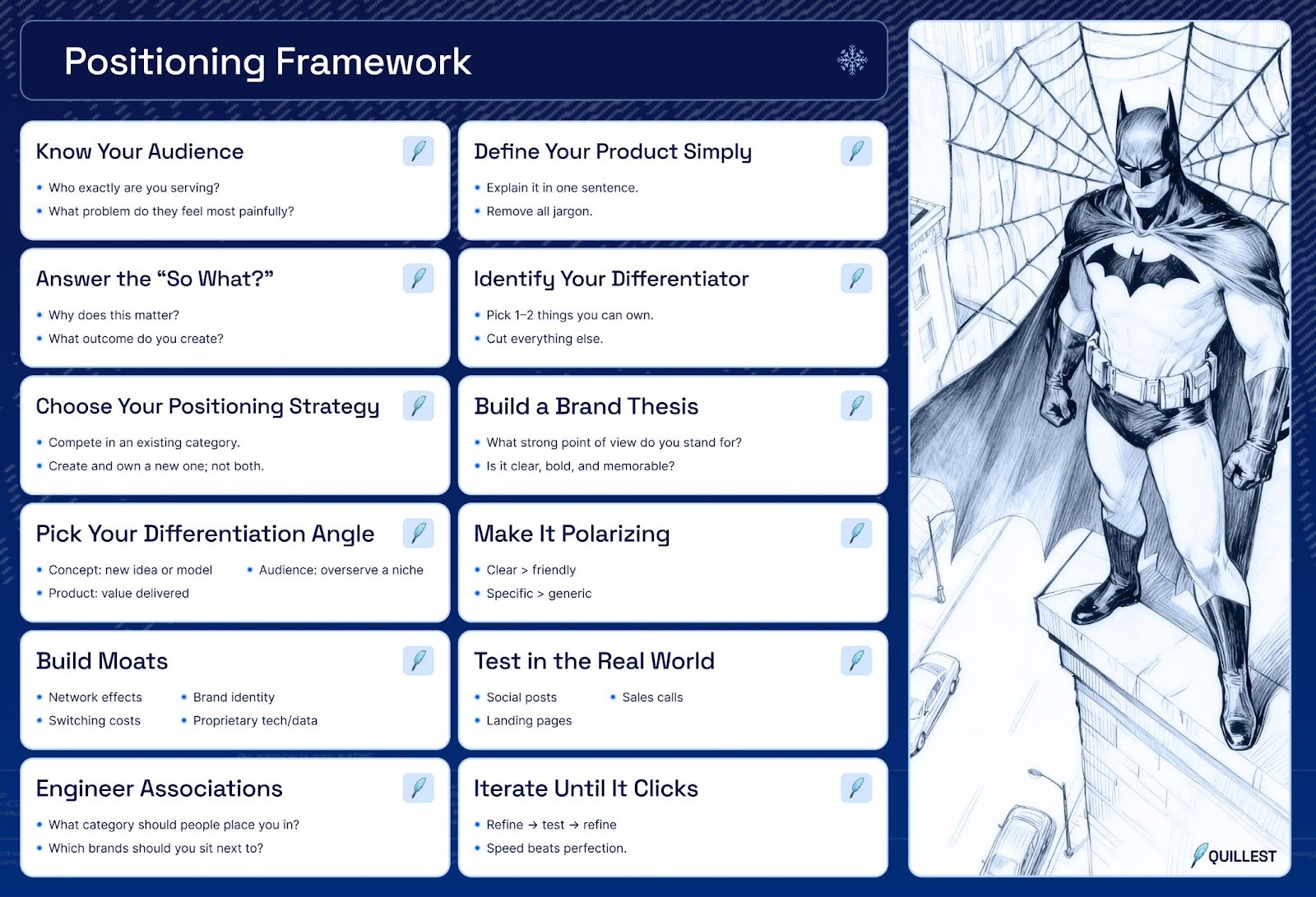
1. Who is your audience?
Not everyone is your customer. Segment clearly:
- Who exactly are you serving?
- What problems do they experience?
- What language do they use to describe these problems?
- How familiar are they with your type of solution?
Brand positioning becomes easier when you know precisely who you're for.
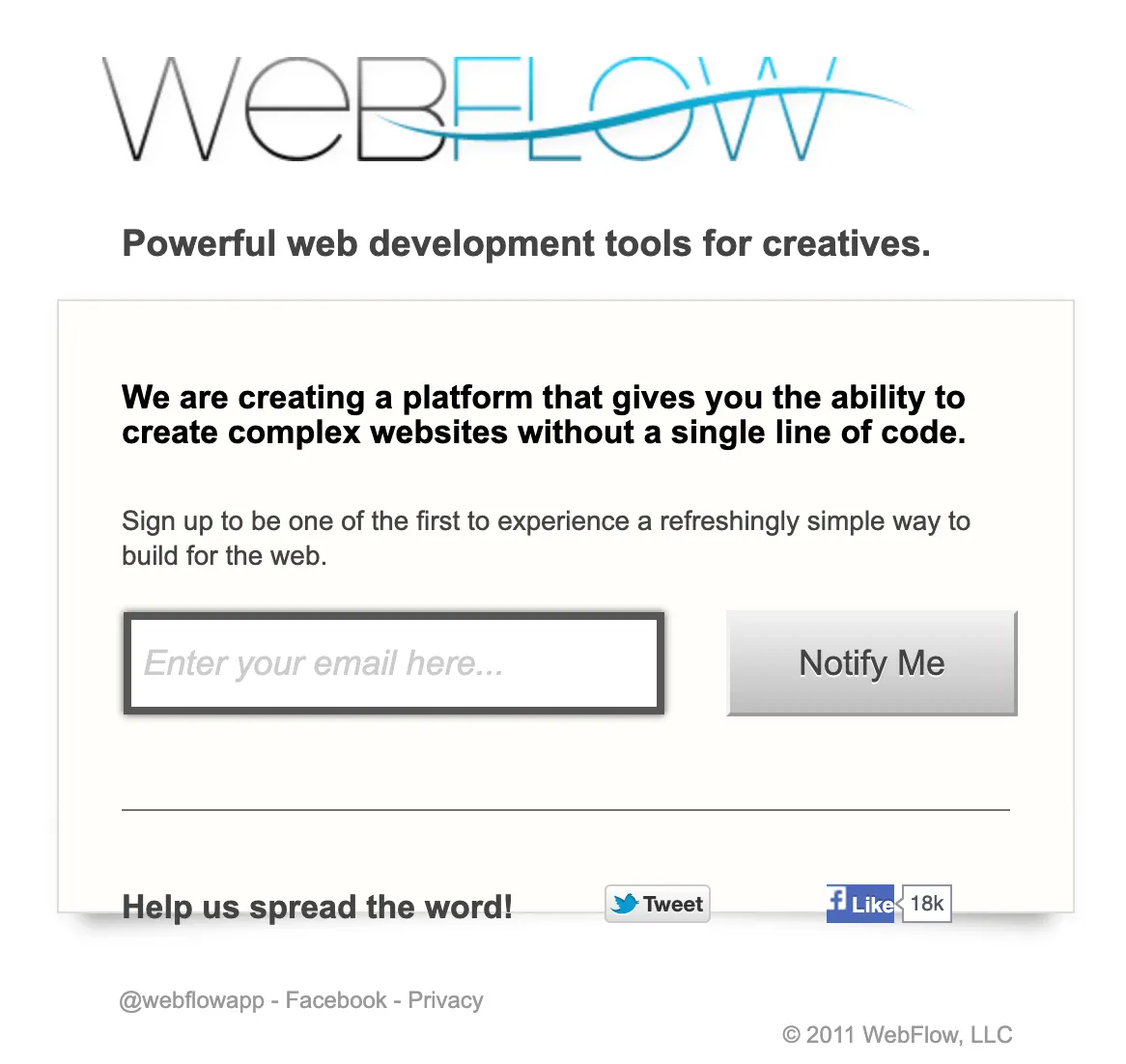
Take Webflow as an example. From the beginning, they defined their audience with absolute precision: designers who want to build production-ready websites without writing code or relying on developers.
Webflow understood their users' pains and desires:
- “I want full control without coding.”
- “I wish I could build this exactly as I designed it.”
- “Developers slow me down.”
By understanding the exact language and frustrations of this group, Webflow could speak directly to them and ignore everyone else. The result was a simple, unmistakable brand positioning: “The no-code website builder for designers.”
It resonated immediately because it answered a very specific pain for a very specific audience. Webflow didn’t grow by trying to appeal to everyone, they grew by focusing deeply on the one segment they understood better than anyone else.
2. What exactly is your product?
If you cannot explain your product in a single sentence, that means you don’t understand it well enough. Hence, customers definitely won’t.
Imagine a startup describing itself like this:
❌ A modular, developer-centric, interoperable financial orchestration layer enabling transfer across global settlement rails.
Can you guess what this company actually does?
Most people can’t.
Here’s the simple, real positioning they actually won with:
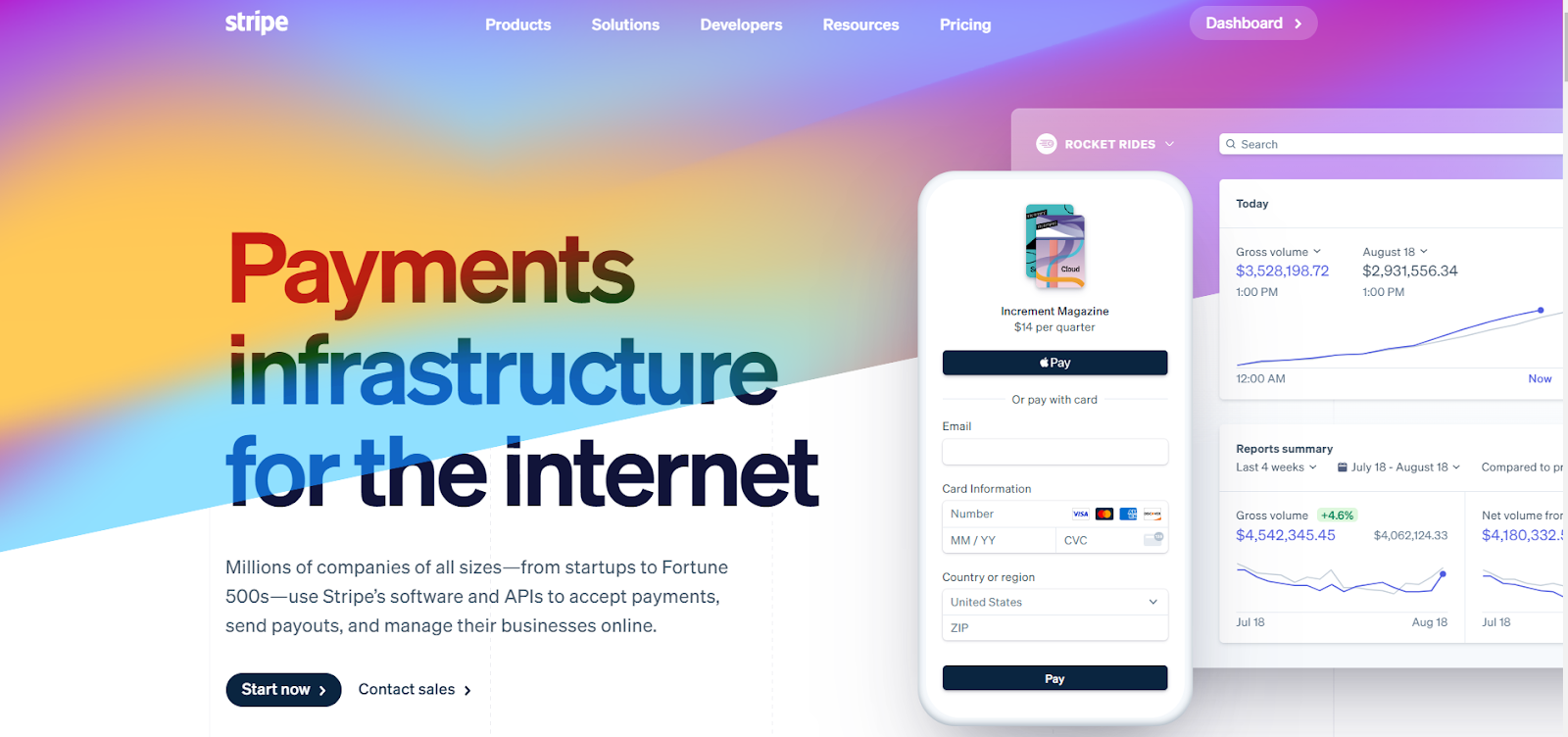
✔️ “A way for internet businesses to accept payments online.”
Now Stripe is what comes to mind first – clear and impossible to misunderstand.
3. ‘So What?’ Drill, or why does this matter?
Many founders skip this part, and it kills their messaging.
Every benefit must answer: So what? Why should anyone care?
Example:
“We automate workflows.” → So what?
“It saves teams time.” → So what?
“They complete projects faster.” → So what?
“They make more money with less effort.” → That’s the core value.
Keep drilling down until you hit the fundamental value proposition.

4. Why should people choose you?
Identify one to two true differentiators. Just the one or two things you can own in the market.
Too many differentiators = noise.
The Two Winning Brand Positioning Strategies
When you study successful companies, almost all of them follow one of two brand positioning strategies, whether consciously or not. Each strategy shapes how you enter the market, how you communicate, and how you win.
Strategy 1: Dominate an Existing Category
The first approach is to step directly into an established category and outperform everyone already competing there. This means identifying the key differentiator that truly matters to customers, leaning into it aggressively, and positioning yourself as the superior choice on that specific dimension.
When you choose this path, you’re not trying to redefine the market. Instead, you’re reframing competitors’ strengths as weaknesses and demonstrating why your angle is the one that wins. This strategy works best when the category is already well understood, the problem is familiar to customers, and your competitors are strong but poorly positioned.
Strategy 2: Create and Own a New Category
The second approach is to carve out an entirely new niche that doesn’t exist yet but should.
Instead of competing head-to-head, you redefine the landscape by introducing new terminology, new mental models, and a new way of understanding the problem. This often requires educating the market, sometimes over a long period, but the reward is worth it: if you succeed, you become the default leader of the category you created.
This strategy is ideal when your product represents a new paradigm, when existing categories force you into the wrong box, or when you aim to fundamentally shift how the market thinks. Creating a category is harder, slower, and more narrative-driven, but the upside is owning 100% of the mindshare.
Why Choosing One Strategy Matters
Where founders go wrong is trying to straddle both approaches. Attempting to “compete” and “create a category” at the same time leads to diluted messaging, confused users, and weak positioning. Effective brand positioning demands clarity about what you are, where you fit, and how you intend to win.
Pick one approach and commit to it fully. The strength of your positioning depends on your ability to choose a lane and stay consistent.
Differentiation: How to Stand Out When Everything Looks the Same
Most products struggle not because they’re bad, but because they’re indistinguishable. Here’s how to create real differentiation.
Build a Brand Thesis
A brand thesis is your worldview, a strong, polarizing point of view about the market.
People follow conviction. People follow ideas. People follow brands that stand for something specific, not “everything for everyone.”
Examples of brand thesis:
- “Every business will become an AI business.”
- “Remote work isn’t the future - it’s the default.”
- “Data privacy is a human right, not a feature.”
Your thesis should make some people agree passionately, and others disagree loudly.
Neutrality = invisibility.
Choose Your Differentiation Angle
There are three primary paths to differentiating your brand, and strong brand positioning often comes from focusing on just one.
- Concept differentiation: Introduce a new mental model or concept. This turns your product into a category.
- Product differentiation: Features are easy to copy. Value propositions are not. Focus on the outcome, not the mechanics.
- Audience differentiation: Overserve a specific niche so well that you become the obvious choice. Specialization always beats generalization when positioning early-stage products.
Play on Your Hyper-Advantages
Once you’ve chosen your differentiation angle, the next step is to design the frame in which you win. Strong brands tilt the field so that their strengths matter more than anyone else’s. This is where “hyper-advantages” come in: the unique capabilities, insights, or assets you have that competitors can’t easily match.
Your job is to position the conversation around the strengths that make you inevitable. If you’re fastest, speed becomes the metric that matters. If your model is more accurate, accuracy becomes the story. If your product is simpler, simplicity becomes the battlefield. You choose the lens that makes you look like the obvious winner.
Netflix is a clear example of a company that built its brand positioning around a hyper-advantage. In the early days, they couldn’t compete with rentals with physical locations, brand recognition, or retail presence — Blockbuster dominated those metrics in the USA. So Netflix reframed the entire category around convenience, unlimited access, and personalization. Instead of making the conversation about “rentals,” they made it about “instant entertainment, anywhere, anytime.” This shift played directly into their strengths: streaming technology, data-driven recommendations, and a subscription model. Netflix became the category itself and made earlier categories irrelevant.

This is your strategy. You’re defining the terms of competition so that you are naturally positioned at the top. When you set the frame, you stop playing by your competitors’ rules and force them to play by yours. Companies that dominate categories almost always succeed because they defined the criteria on which the category is judged.
Love or hate you — either is good
The worst reaction to your brand is indifference. When people feel something - positive or negative - your brand becomes memorable, and memorability is the foundation of growth.
Polarization = attention.
Attention = growth.
How to Implement Your Brand Positioning in the Real World
A brand positioning strategy only becomes valuable once it’s actively used. You don’t know if your message works until real people interact with it, respond to it, and either lean in or look away. Implementation is where strategy becomes traction.
Test your messaging
The fastest way to validate your brand positioning is to put it in front of real audiences. Share it through social posts, landing pages, ads, email sequences, or even sales conversations, and pay attention to how people react.
- Does it resonate?
- Does it confuse?
- Does it convert?
Engineer the associations you want
Every brand occupies mental real estate. The question is whether you’re shaping that space intentionally. Ask yourself:
- Which companies do we want to be compared to?
- What category should people mentally put us in?
- What words should people associate with our product?
If you don’t intentionally architect your category, others will misplace you.
Iterate constantly
Strong brand positioning rarely appears fully formed. It evolves through cycles of testing, learning, and improving. Expect to revise your message multiple times until it feels intuitive, differentiated, and unmistakably yours. In positioning, speed of iteration matters more than perfection; the more you test in real conditions, the faster your clarity emerges.
The Real Reason Brand Positioning Matters
When your brand positioning is strong, everything in your business becomes simpler.
- Customers understand you
- Marketing becomes clearer
- Sales cycles shorten
- Investors “get it” faster
- Word-of-mouth spreads
- Talent wants to join
The opposite is equally true. Weak brand positioning forces you to work 10x harder for half the results. If your product is solid but the market isn’t responding, the answer usually isn’t more features or more marketing campaigns. It’s clarity. It’s alignment. It’s positioning.
When you master your position in the market, the rest of your go-to-market strategy stops feeling chaotic and starts working with you instead of against you. Clear brand positioning helps you win.
If you want support defining or sharpening your startup’s positioning, let’s chat at https://www.quillest.co/.
Be the one AI Recommends
Looking to scale revenue, never worry about your pipeline again and become a market leader?
Let's chat.